Tuesday, December 2, 2014

Obituary: K.S.Dalpatia


               (1969 batch of Shyamlal College Evening. Mr. K.S.Dalpatia is fourth from left)

Krishan Singh Dalpatia (1938-2014)

I lost a very dear friend last month. He was evidently not the first one to leave this world; nor would be the last since God’s ways are only known to Him. But after he left for his heavenly abode, I continue to feel his absence every day. The time I spent in his company, and much of it arguing since we rarely agreed, continues to haunt me. He was surely one the like of whom one rarely meets in life.

I met him first in 1971 when I began working. He was quite senior to me in years and experience and relished teaching Hindi to overflowing classes. He was known for his loud raucous laughter, which began to be heard from the college gate itself. A colleague likened him to good old B&W televisions, which emitted sound first & the picture would appear several minutes later. He was equally loud and assertive when expressing his preferences for people. I did not like the way he publically supported some people without applying his mind. We argued about it over a cup of tea outside Old Delhi Railway Station. As I let loose a barrage of questions at him for being so immature & trusting, he weathered it smilingly. In the mean time, a poor man approached us and begged for a meal. Before I could wave him away, Dalpatia sahib ignored me, turned his head & told the dhaba owner to serve him a meal. I got up indignantly but he was cool and replied disarmingly, “Okay! I shall not do it again.”

“Are you free on Sunday morning?” he once asked me casually. Being a late riser, I was cautious and asked for more information. The National Service Scheme (NSS) unit of the college was organizing an event in Seelampur and he wanted me to attend. It would not take long and we will also serve you tea later. I was not very enthusiastic but gave in. When I reached the colony, I found a huge heap of garbage, rotting for days and emitting a very foul smell at the entrance itself. Mr. Dalpatia was at the top of it and feverishly shoveling it away along with volunteers. This happened several decades before our PM launched a ‘Swachta abhiyan”. I was equally aghast when I spotted his son, who must have been below ten, following his footsteps. It was really very nauseating. I protested why he was exposing his small son to such unhygienic conditions. He smilingly responded, “Let him know this face of India too.” I was also taken to see the results of a plantation drive our NSS unit had undertaken and a road built with villagers’ participation in rural areas. When funds from Delhi School of Social Work dried up, he organized a fete in college grounds where he put a bottle of beer among prizes to be won by throwing a ring. It nearly cost him his job!

Mr. Dalpatia had a keen interest in politics. His opponents, and there was no dearth of them, put labels of different parties and their groups on him. Some claimed that he was an RSS man but I found that he had friends across the political spectrum, including the Left. There were some who claimed that, post- Emergency, he was sympathetic to Janata Party leaders. This could be a reaction to the fact that he was hounded by the college authorities during the infamous Emergency. I personally don’t think he wore any ideological blinkers; he was genuinely concerned about teachers’ issues & welfare. He was severely criticized by political groups when he demanded housing/medical benefits & full-time DPEs & Librarians in Evening colleges when contesting for DUTA. Over time, these demands became the agenda of all teacher-groups and once realized, ameliorated the lot of teaching community.
He landed at my door one morning and asked me to draft his resignation letter. The bank had refused further credit to his brother’s enterprise till it was turned into a partnership concern. He wanted to be relieved that very day & was even willing to pay for the 3-month notice period. I reasoned with him but he said it was unavoidable. Thus, he bid adieu to college and dedicated himself to building an ancillary unit, which was to employ over a hundred workmen & supply quality components to reputed brands of Indian industry. He offered placements to young men graduating at such far off places as Chennai and steadfastly followed ethics in doing business. The core unit, appropriately named Navyug Udyog, survives to this day.

I met Mr. Dalpatia last only a few days before his sad end came. He was as hospitable and cheerful as ever & rebuked me for showing up late. We were served fried fish, which we feasted upon & relished. I think he was a visionary who could see ahead of his times. Besides, he was essentially a man of action, a Karamyogi, who had often accused me of deflating his grandiose visions with a pin of pragmatism.  I was sorry to see that his impaired vision was robbing the fiercely independent man of living his life entirely on his own terms. He had always been so brave in life; I am sure, even in after-life, he must be setting new standards of excellence.

May his soul be blessed and freed from the cycle of birth & death. Amen!


Tuesday, August 19, 2014

Mission Kashmir!

India has called off foreign secretary level talks with Pakistan- a week before they were to be held in Islamabad as a follow-up to Nawaz Sharif’s presence during PM Modi’s swearing in. The immediate provocations were meetings, despite forewarnings, between Pakistani envoy to India & separatist leaders of J&K. Since such interactions did not take place for the first time, therefore speculation about the real reason for calling off the talks dominated Indian media debates. While the supporters of BJP govt. overwhelmingly saw it as an assertion of strength by the new prime minister who sent a clear message to Pakistan that it will have to choose between Indian govt. & a motley group of its supporters in Srinagar under the umbrella of Huriyat Conference. The Opposition, mainly Congress, initially criticized the govt. for going ahead with talks notwithstanding continuing ceasefire violation by Pakistan but changed track later highlighting that the decision should have come sooner if at all.

The truth is that India has been found wanting in dealing with a rogue state like Pakistan, which has been hell-bent on creating trouble in J&K since 1947 when Pakistan invaded it to ensure merger of a Muslim-majority state with itself while its Hindu Maharaja, keen on independence, opted for accession to India to save it from the same fate. The festering dispute, which has taken a toll of several thousand lives and valuable resources during the last 66 years, could have been resolved on several occasions had the Indian political leadership of the day risen to the occasion. Unfortunately, it did not happen!

When Indian forces landed in Sri Nagar following the signing of the Instrument of Accession by Maharaja Hari Singh, they were just in time to stop the Pakistani tribesmen from capturing the valley. But the time was also ripe to carry on the military operation to its finality. However, the idealist in Nehru got better of the strategist. Nehru thought and not wrongly at that time that Kashmiris will prefer to opt to live in a secular India than in the new nation born out of religious bigotry, hatred & violence. As a liberal humanist & a Kashmiri Pandit himself, Nehru had confidence in his people. He took the issue of Pakistani invasion of Kashmir to U.N. and the rest is history. India could and should have carried on the military operation to its conclusion and reclaimed what is now called POK or ironically, Azad Kashmir by Pakistan.

The 1965 war with Pakistan was fought when Lal Bahadur Shastri was at the helm of affairs in India. Objective analysts believe that military gains were shared by both the parties. While Pakistan made some territorial gains in J&K, India neutralized them in other sectors. A ceasefire followed & USSR intervened to bring the warring nations to bargaining table.  The Tashkent agreement, ostensibly forced upon a reluctant India, enjoined upon India & Pakistan to retreat to positions held before the war started. Therefore, it was another diplomatic disaster, which also tragically ended our prime minister’s life abroad.

The third opportunity to resolve the Kashmir issue presented itself following Pakistan’s rout in 1971 war. Indian military also made significant gains on the western front while taking 80,000 soldiers as POWs following the famous Dhaka surrender by Gen. Niazi. The stage was ripe for a lasting solution to Kashmir but Indira Gandhi frittered away the gains on the bargaining table in Simla next year. Bhutto pleaded that India had inflicted enough damage by finishing East Pakistan. India offered to return either the territories in the western sector or the POWs held during the war under the false impression that Pakistan would prefer the latter. Bhutto promptly asked for the former and explained later that India could not hold on to its men indefinitely. If Indira Gandhi were as cunning as the wily Sindhi from across the border, she would have insisted on Pakistani withdrawal from POK as the only precondition for both.

India was fourth time unlucky when it was let down by the NDA govt. at Agra in 2001. Pakistani dictator-cum-president, Parvez Musharraf, was being hosted at the summit by Atal Bihari Vajpayee. Gen. Musharraf, an army man and architect of Kargil war during Vajpayee’s Lahore Bus Yatra, was keen to go down the annals of history as a game changer. He appeared willing to rule out solutions unacceptable to both India & Pakistan and look for unconventional ideas, including making borders porous and irrelevant. Musharraf was a hard core military commander who was determined to accomplish a difficult mission in a flamboyant style. When the agreement was about to be inked around midnight, Musharraf’s move was checkmated by our Sindhi.  L.K. Advani, then PM Vajpayee’s deputy, reportedly fielded Sushma Swaraj to address a press conference around midnight, which scuttled it.

With Advani’s bête noir Modi as PM and his protégé, Sushma Swaraj as the MEA calling off the talks now, will another opportunity to resolve the Kashmir imbroglio present itself anytime soon?  Only time will tell!
***


Tuesday, July 22, 2014

The Pilgrimage!


I sat quietly as my mind turned over leaves of the past! That morning, decades ago, in the distant Tirumala town, I trudged along the lanes, clueless & lost, finally asking my small daughters with a sense of guilt if they would like to stand in the serpentine queue or prefer going downhill to the Tirupati station, without a glimpse of the deity. Today, the scene was being re-enacted. After a tortuous climb, with minutes ticking by, I told my spouse not to worry about me & to pay her obeisance at the shrine alone.


My first visit to Vaishnodevi shrine, nearly 20 years ago, was instinctive. On a visit to Jammu to attend a wedding, I had a couple of days to spare so just boarded a bus going to Katra, barely 50 kms away. Alone & ill-prepared for the wintry night ahead, I had trekked the 13 odd kms from the base, Bamganga to the shrine called the Bhawan in about four hours. The climb gave me picturesque views all around, as the rays of setting sun set the sky afire & drew, as if by a pen, the course of the river below. As I lay shivering badly in the open that night, my thoughts were anything but spiritual. I had, during the late evening darshan, sought to be forgiven if I could never come again.  But that was not to be.

The Met office had predicted heavy rain the day on March 11, the day we reached Katra town. I realized that we can no longer dismiss its forecasts with contempt. People were selling cheap white raincoats for 15-20 rupees that barely last the journey. Shamed by the faith of pilgrims, who looked like nuns in them & even carrying small children, we too decided to take the plunge. It was an ordeal with intermittent heavy showers slowing us down to a crawl. The route is dotted by small shops whose owners did not mind if we stepped in or sat on their benches, without buying anything. I was reminded of Delhi where shopkeepers use all means, even ramshackle bikes & scooters, to ensure open access to their shops.

We reached Himkoti, the point where one turns left for a shorter route uphill & found the white gate closed. The announcements over the public address system explained that there had been landslides above. So the guards waved to us to turn right towards Ardhkwari. The milestone revealed we were doing a pathetic 1 km an hour with our backpacks pulling us backwards & wondered whether we would reach the Bhawan even around midnight. It is curious how your spirits are lifted whenever you feel very low. As we turned a corner, a swanky Coffee Café Day greeted us. We looked at each other & decided to take yet another break. A cup of coffee is always welcome!

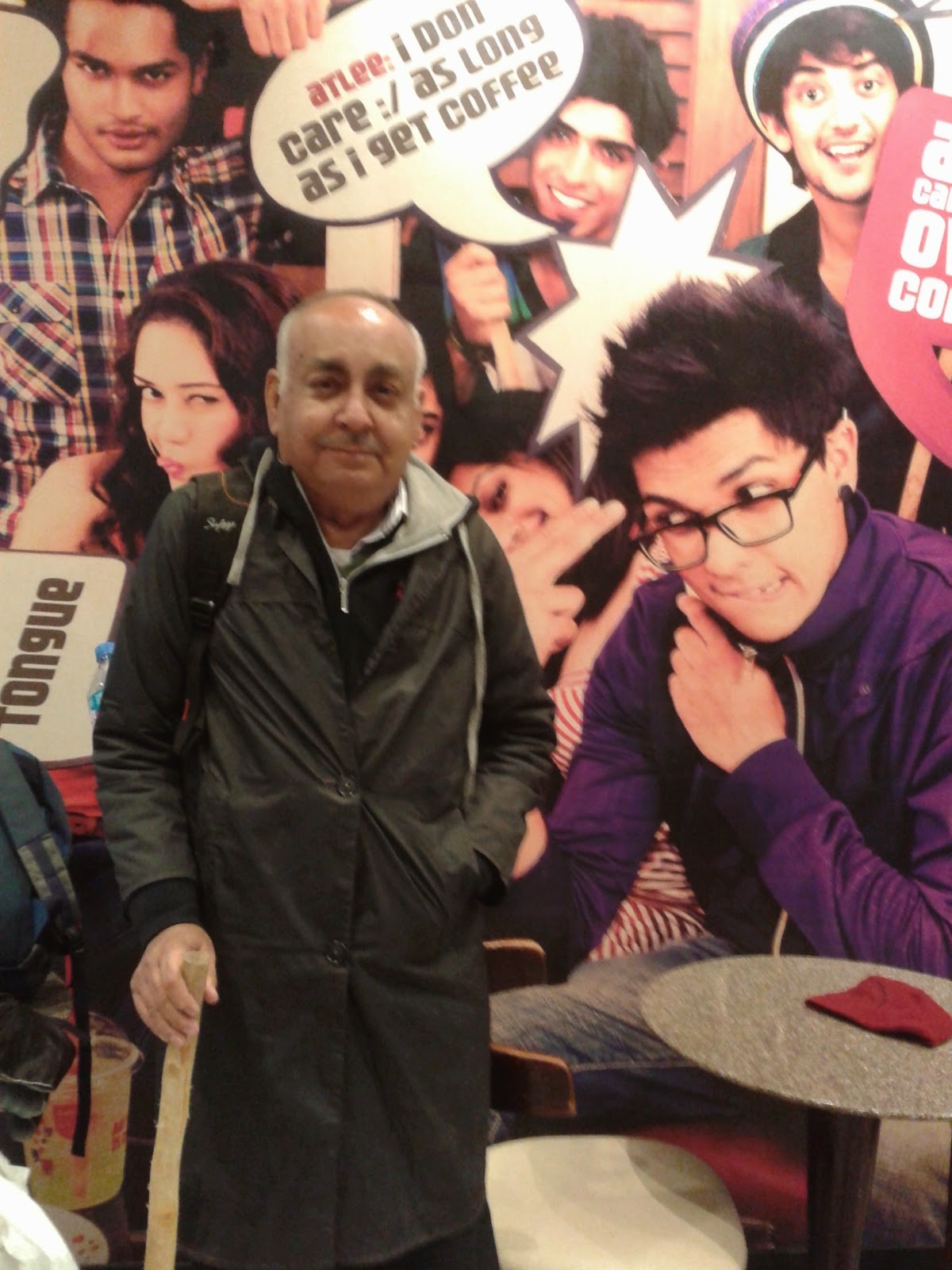
A heavy shower pushed even the unwilling ones inside. These included lanky & tough Kashmiri porters who carry toddlers & baggage all the way up. I liked the way they were brought in & fed by the pilgrims they were escorting. A group occupied a corner & beamed smiles over the tiny cups of cappuccino. I clicked them together & got his walking stick as a return gift. When I showed reluctance, he reassuringly said, “We’re going downhill & don’t need it but it will help you climb.” By the time, we came out, it was dark. We decided to use the room we had booked as an abundant caution where the staff advised us to resume our journey in the early hours. ‘Your mind & body shall have rested by then’! A stormy night lay ahead. We skipped the dinner, gulping a few biscuits & a painkiller each to relax our strained calf-muscles. The elements flashed, thundered, whistled & howled outside. The 4 o’clock deadline to resume the pilgrimage came & went.

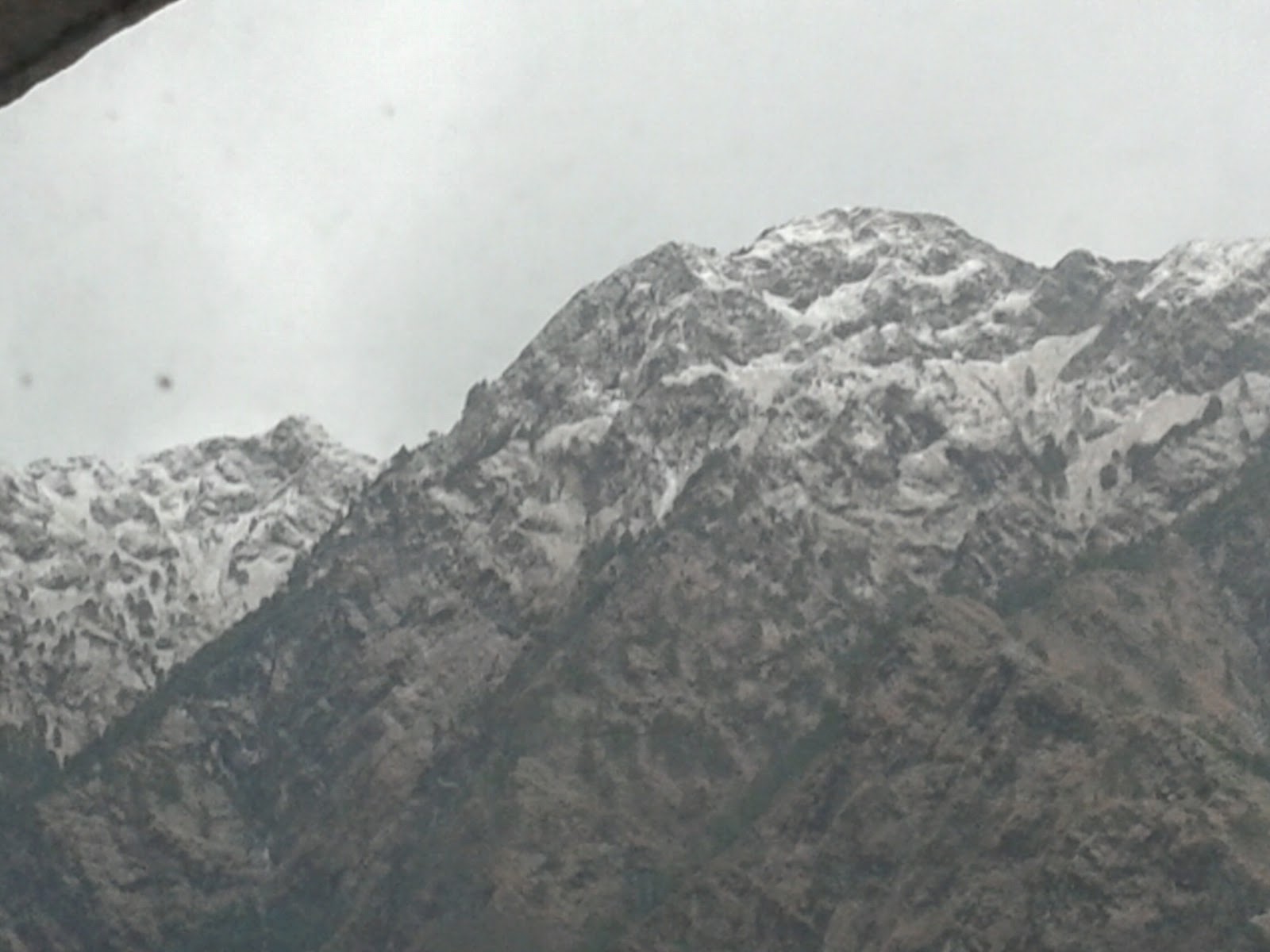
 When we stepped out in the morning, the peaks in the distance were all covered in snow while hailstones covered the ground all around. A few monkeys jumped around looking for food & when threatened, took refuge in an abandoned room close by. Some fellow pilgrims told us that they were returning to Katra since weather was very bad & all access roads above closed due to landslides. It was disheartening but I echoed the same opinion over cup of very sweet tea & pakodas spattered with red chilies. We looked in the direction of the shrine & took a U-turn.  A few steps later, she complainingly asked one of the security guards if there was no way we could carry on with the pilgrimage. To her utter surprise, he revealed that we surely could since the landslides had been cleared. I recollected that Met office had predicted that the weather would clear the next morning so we decided to go ahead.

Covering the first mile was a bit unnerving as we wandered ahead like two lost souls on that stretch covered with heaps of hailstones that had begun to melt. The clouds overhead began to scatter. The first rays of sun lit up the blue sky. The view on the ground was disturbing.  Plastic sheets & tin scaffolding supporting it had blown off during the night & hung precariously at places.  We saw embers of bonfires around which the poor porters must have taken shelter while the storm raged on.  A few of them now accosted us and offered to carry our bag packs. ‘They are empty’, I argued but gave in when one of them pleaded that he had not earned a penny since last evening. Soon the paths merged and we could see the first brave souls coming up amid cries of ‘Jai Mata Di’!

The going was quite tough. I needed to take frequent breaks during one of which the porter massaged my legs and back. I tried to stop him since I don’t like anyone handling my body but it was so relaxing. For the rest of the climb, he pushed my back gently with the palm of his hand. Rejuvenated, we trudged along as workers of the shrine board descended clearing the path of debris & hailstones. Sounds of prayers wafted down the slopes into the valleys. We kept on discarding layers of warm clothing as the Sun rose in the distance and revealed a breathtaking view of Katra town below & snow-covered peaks above. At the entrance to the shrine, the porter told us that he could go no further. ‘Compensate me like a father does his son’, he pleaded.  I hope he was not disappointed.

‘You have fifteen minutes to finish the obeisance’, I explained to my wife who looked bewildered & then ran forward. I sat outside with the back packs & closed my eyes in prayer. When I looked around, I couldn’t see another soul who had come that far & was returning without a glimpse of the Goddess. ‘To each, his own’, I told myself wistfully & sipped the rest of tea that was going cold. We rushed as directed to the pony stand where I rode one for the first time. ‘Sit erect’, its burly Sikh owner shouted at me as I tilted dangerously over the short animal. For the next half an hour, it kept tossing me while I clung to it as the proverbial last straw.

We reached the Sanjhi Chat helipad just in time for our maiden journey. I could see another helipad in the distance, which I learnt belongs to the armed forces. ‘You two sit in front & stay away from the controls ’, the staff told us. I glanced at the pilot who ran the shuttle mechanically & didn’t even look towards the passengers. The chopper rose vertically, swayed, dipped and went round avoiding several cliffs to touch down after a ten-minute flight at Katra.

 Thus ended a pilgrimage for me that was not to be!


Sunday, August 4, 2013

Fighting Stress-Vedanta style!
The SMS promising a ‘stress-full to successful life’ proved to be irresistible. I dutifully forwarded it to many friends whom I considered spiritually-inclined. Last time, I went to Jaya Row’s lecture at Kamani & took some friends along, there were complaints that what began on a loftier note ended up with a whimper. While her readings of Bhagwad Gita made a lot of sense to lesser mortals in the mundane world, the whole exercise turned into a marketing exercise to sell seminars, CDs, books & DVDs toward the end. Therefore, no wonder a reply from a younger colleague stated that she, ‘instinctive and spontaneous as she was’, could no longer adapt to Jaya Row’s ‘corporate culture’. Nonetheless, I made it to the venue with fewer and newer friends, assuring myself during Ms. Mudgal rendition of beautiful bhajans that the event at least gave us an excuse to meet & discuss what she taught.

Jaya Row began with evolutionary terminology stating how homeostatic mammals progressed to human’s mental statis (it went over my head!) to elucidate how Vedantic Samam or equanimity was the ultimate key to success, happiness & growth. The state of equilibrium or calmness isn’t inactivity but one leading to an intense, vibrant action. Mental agitation, on the contrary, is caused by our inherent negativity toward one and all, resultant desires to rid ourselves from them but making ourselves all the more attached & finally stressed in the process. Row is fond of marital references to spouse, mother in law as targets of our ire & manages to strike a chord & draw an instinctive applause from the audience.

Stress was, however, defined as an ‘internal phenomenon’ implying thereby that we end up with it when we become reactive and fault-finding to people or situations around us and therefore its cure also lay inside us. Switching to a vocabulary suited to the young (the auditorium is usually full of bald, graying heads whose life-game may already be in the mandatory Overs) and pleading with them to move from being enumerators to denominators, she explained how our uncontrollable mind overwhelms the intellect we are blessed with to cause agony and stress. Therefore, what we need is an overpowering intellect to keep us calm & serene when life becomes topsy-turvy & turbulent and take it head-on. Sportingly, she gave the example of Tennis legend, Billie Jean King while my mind meandered to Michel Jackson’s number by the same name. It did prove her point about minding our mind!

Poor intellect leads to a spate of desires. If fulfilled, they lead to a state of delusion, blind pursuit of wealth & power, leading to envy & arrogance. My thoughts turn to Durga, the young, valiant civil servant at the receiving end of politicians in UP. Row, however, spreads the net wider claiming politicians will always be ‘corrupt’ & Indians, ‘indisciplined’. She pointed out how affluent parents, for want of time, shower gifts and gadgets rather than love upon their children these days. When the desires are unfulfilled, it prevents enjoyment of what we have, destroys relationships out of envy and even compromises values as we choose unethical ways to get what we desire so strongly. Ch. II, verses 62-63 of Bhagwad Gita begin to ring in my mind where man’s degradation to destruction is traced from attachment, desire, anger, infatuation, loss of memory & reason to ultimate ruin. Jaya Row’s views are essentially rooted in Bhagwad Gita, which she crafts well to meet the needs of varied audience.

What is the cure, then? We need to rekindle the ‘higher self’ within us. Desire things by all means; but don’t crave for them. A flow-chart on the screen explains how ‘Desire management’ leads to relief, reducing them to comfort and using intellect to define them saves us from these ‘weapons of mass distraction & destruction’. The ultimate aim is to integrate mind, body & intellect to realize eternal bliss in the form Atman.


Jaya Row gesticulates angrily to the young lady in waiting why she isn’t on the mike  to announce what happens next while she tries to convey that Row has yet to finish with the last slide dealing with ‘Take Home Points’. Stress confronts us at strange times! 

Tuesday, January 22, 2013

Child Labor & FDI!

Just saw a documentary produced by BBC under Our World series dealing with the problem of child labor in cotton industry in India & cocoa in Ivory Coast-both employing child labor, often enslaved and earning nothing at a tender age. The weaving unit in India from whom leading brands like GAP, Marks & Spencer etc sourced supplies looked okay in terms of working conditions & wages but the owner could not claim the same below the spinning unit. Since the supply chain begins with picking up of cotton in the fields, action should also begin from there. The responsibility must be shared by the local govt. under whose jurisdiction the laws prohibiting child labor & minimum wages are violated & the brands in developed world, which charge exorbitant prices but care little about the poor people at the first stage of supply chain.

As we introduce FDI into various segments of Indian economy, we should ensure that the benefits of investment flow to the poor of the poorest & we are not just exploited as a market. The stipulation for companies like Ikea, which have been granted permission to set up businesses in India, that a fixed percentage of material must be sourced locally should stay. At the same time, steps must be taken to ensure that no child labor is involved at any stage & remunerative wages are paid to everyone. Wonder why our own media remains confined to political debates in the capital & cannot do stories revealing how politics & economy is actually impacting the life & living of our people in a globalized economy!

On Attires & Culture!


Following the infamous gang rape case of Delhi, one assumed that Indian males would reflect upon the traditional bias against women & correct their mindset. After all, we worships goddesses & deities in our homes everyday and seek from them blessings in the form of knowledge, wealth, and security. Our nation too is our ‘motherland’. But reactions to the ghastly event brought out again how we as a society discriminate against women both at home & outside. The bias cuts across the political & social spectrum. A Congress MP described the protesters crying for change in rape laws as ‘dented & painted women’ implying perhaps they did not represent the real or Aam women. The remark led to a huge outrage forcing him to apologize & retract what he had said. The BJP performed no better. An MP Minister mentioned a Lakshman Rekha for women- you cross it and you would be punished like Sita! The RSS Chief termed marriage between man & woman as a ‘contract’. The woman serves the man & he provides her security. Whatever happened to our much not only means shifting the onus of crime from accused to the victim but revered culture! There were snide remarks opposing everything that women do-using mobile phones, wearing western wear or working late. It is curious how one can blame wearing of jeans for sexual assaults on women. Men of all ages are seen clad in jeans without an eyelid being batted. Besides, linking of attire to culture is ironic. How are khaki shorts worn by RSS workers in consonance with Indian culture? If we go around the country, we can see dhotis, lungis, pajamas &, churidars in plenty but not one ‘Aam aadmi’ in British army-style khaki shorts. Raising such non-issues also violates the principle of equality of sexes enshrined in our Constitution. If men are free to dress up the way they like, let them not preach sermons to women because the fault lies with men.  When a Pir, a spiritual healer of eighty rapes a minor of thirteen in Kashmir or a young rickshaw puller sexually assaults an eighty year old & dumps her in a Delhi park, you can’t blame the victims or the way they dressed. A placard at Jantar Mantar aptly asked:  why should a woman feel ashamed when it’s the men who have a dirty gaze?

Sunday, October 14, 2012

From Agnosticism to Faith!


The weekend involved a strange struggle with maters of spirituality. On Saturday, HT carried the preface of ageing Khushwant Singh’s ‘The Freethinker’s Prayer Book’, which will hit the stands around the time he turns 97.  Khushwant Singh begins with his birth in a conservative Sikh family of Hadali (now in Pakistan) when, as a child, he liked the rituals of his faith. It transports me to my own childhood, led by my grandma to a local gurudwara in Old Rajinder Nagar, sitting through the prayers patiently, waiting for that handful of steaming hot ‘kada-prasad’. Khushwant Singh began to question the rituals & dogma during his teens when studying at Delhi’s elite Modern School. In contrast, I went to a local aided school but chose to sit outside a dark, dingy temple in far off Kerala, taking care of my schoolmates’ shoes rather than change over to a dhoti to gain entry. Here the similarity ends.

Khushwant Singh understood in college how science & technology as well as the liberal arts in the western world impacted religion. Wisely, he kept his skepticism to himself while his awareness of fragile foundations of faith (rather faiths) grew in college. He touches upon prevalence of untouchability in Sikhism & claims that all religion are irrational, full of superstitions and encourage ignorance, generate more prejudice & hatred than love & friendship. Ironically, his observations appear around the time a memorial is coming up inside the Golden Temple in memory of those who were killed during ‘Operation Bluestar’. He challenges God even as a concept, dismissing with a straight face any bearing God has in making us good or bad. ‘For every Mother Teresa or Baba Amte, there are thousands who have killed & raped in the name of their gods’ & ‘the masterminds of 1984 (wonder why no one talks about rampant violence in pre-1984 Punjab!) & 2002 pogroms are ministers and party leaders. Neither the law nor God has made them pay for their crimes.’ Strong but true words though I sometimes wonder why those pulled out of buses, segregated &am killed point blank in the fields of Punjab never find a mention in the violent history of Punjab.

There are two things that are quite perplexing. Khushwant Singh, despite giving up organized religion, ‘continued to retain the outward emblems of the Khalsa because it gave me a sense of belonging and social security’. Does it mean that however much of a rationalist one may be, one still needs an emotional anchor in life? The heading of the piece calls him the ‘eternal agnostic’. He claims that he is not a man of faith, nor believes in paradise or the possibility of rebirth. With no idea where he will be after he dies, he finds himself staring into an endless dark void. Isn't a long life full of opportunities, fame, knowledge & money is expected to yield rich dividends in the form of enlightenment?

Sunday’s quest for spirituality began with Jaya Row at Kamani. She started off with a reprimand for those who cannot even take out for days in row in a year to hear her discourses on Bhagawadgita. Having missed the first three days, I squirmed but stayed on. Chapter XII of Bhagawadgita shows Krsna explaining to Arjuna that the ‘best followers of Yoga’ (Baba Ramdev flashed through my mind!) are those endowed with supreme faith and ever united through meditation with me, worship me with the mind centred on me. (v.2). Frankly, it is all easier than done. Whenever I have tried to meditate, I doze off & to mind one’s mind with varied thoughts crisscrossing every second is a herculean task. I try to focus on Jaya Row’s face, which looks stern like a school-teacher’s with an occasional smile thrown in for politeness sake.

Jaya Row laments how the nation has failed to make any investment in teaching values (Remember the moral science classes at school?). Row highlighted how we remain occupied with body, mind and intellect & forget the Atman, which remains free from joy, anger, fear and even remorse. We need to be contented with what we have since we get what we deserve, not what we desire. Once we control our burgeoning desires, we may lose the temporary joy of seeing them fulfilled but also the fear of un-fulfillment and the sorrow that follows.

The key word is ‘surrender’. Aim high, be ‘daksha’ or competent yet ‘udasin’ or uninvolved (I thought a better word would be ‘unattached’). Such action is ‘Satvic’. If you think you are the doer, you are a ‘bhogi’; if you believe you are doing everything, a Yogi (practitioner) and if you know you do nothing implying you just carry out the divine will, a jnani (knowledgeable). Hence renounce everything! Do not exult, hate, grieve or desire. Remember mind is fickle, intellect is steady: it is faith that takes us to the supreme goal. To fill the void within (Khushwant Singh staring into an endless dark void!) with light, Krsna calls upon Arjuna to be free from opposites like ‘pleasure & pain, ..without attachment to home, fixed in mind & full of devotion to Me’. Ultimately faith conquers even when the rituals fail! Surrender thyself to the Almighty God! 

 As the organizers talk about the discounts on CDs at the counter outside, my friend says we have heard it before & we return to the worldly ways.