My strongest regret in life has been my inability to visit the East. A single visit, lasting only forty eight hours, to Calcutta in early Seventies hardly did any justice to the region. Bengal was in the grip of Naxal violence then (seven people were shot down the day) so I latched on to Rai family when they revealed their plans to visit Sikkim & Darjeeling. Sikkim was knocked off the itinerary by a quake measuring 6.2 on the Richter scale causing a loss of over hundred lives. So we substituted it with the sleepy Kalimpong town.
The flight from Delhi takes less than two hours to Bagdogra - a small airport with archaic facilities and a disinterested Staff. A tourist, who looked like a Chinese, merrily recorded from the pick-up bus everything, including military choppers taking off in the background apparently on rescue missions to devastated Sikkim but no one seemed to care. So much for our security concerns.
The drive through Siliguri to Kalimpong was an extremely rough & bumpy, with patches throwing up so much dust that it could cause an asthmatic attack. The car had to swerve from right to left to protect the suspension from potholes. Gosh! It took an extra hour to reach the small town & another two wandering around it to locate Orchid Retreat on Rinchingpong Road. A smiling hostess later explained that it was a private estate, which did not advertise itself commercially. A quick homely lunch & a breathtaking view from the cottage managed to soothe our nerves.
The small Kalimpong market shuts itself pretty early. The hostess also warned us that it will not be possible to get a cab after 8 p.m. So we were dropped at a corner where the golgappas, neatly stacked in transparent plastic, could be had for a song. The SBI ATM, with the shutters down, had a long queue outside. We spotted the restaurant, Kalash, & went inside. Last order for dinner at 7.30 p.m.! This left us with little time to explore. All we could see was a Durga Puja pandal on the road (there’s one on every street), which had turned one way. We ate a survival dinner and were refunded the coffee charges as the clock struck eight. In Kalimpong, It is the lights out time.
There was no TV in the Cottage’s rooms, which was a blessing in disguise; nor any newspapers with their daily dose of negativity & sensationalism. The small balcony, in front, had comfortable bamboo chairs. Over the railing, one could see lights, twinkling like stars, on the distant mountain slopes. In the clear sky above, the half moon spread its silvery light across the horizon. Jagjit Singh & Ghulam Ali’s ghazals played out of our mobiles. The melodies wafted through the mountainous air. Baat niklegi to door talak jayegi! It was sheer bliss!
The morning at Orchid Retreat was heavenly. We could hear the gurgling water of a stream from somewhere down below & decided to check. There was a rich variety of fauna & flora growing in abundance all around. The steps stopped after awhile with a wooden log blocking the way. We climbed over it and went through a path, which took us to the point where water gushed down a slope. As it wound its way round boulders & stones, it also carried a lot of garbage. We may someday give up the habit of littering.
The dining hall above was spacious & tastefully done. The teak panelling on the walls; the wooden floors & ceiling gave it a heritage look. Books for those who are fond of reading but the kids accompanying us were not bemused by the titles like ‘Hitler’. I could persuade the vegetarians amongst us to try an omelette and won a couple of converts. The mountains, lit by shafts of sunlight, & moist with overnight mist, peeped through the window. The beauty of nature is bountiful!
Delo Top afforded a good panoramic view of the mountain ranges around. A man could be seen para-gliding at a distance. We clicked a few pictures & descended to the Singh Dham temple where a large statue of Hanuman stood atop a hillock. Choosing steps over the ramp, we reach it & bowed our heads in reverence. My colleague commented favourably on the Hindi spoken by the priest but beat a hasty retreat when the latter revealed that he was a poet too.
Dr. Graham’s School, which attracts students from Sikkim to Kolkatta, was in state of repair. The church had suffered a major crack and was closed to visitors. The corners of some class rooms had come apart & were being filled. A blackboard showed English tenses were being taught when they broke up. A Class VII girl had left her school diary behind, which showed stickers of Valentine’s Day & Hanna Montana stuck on different pages. Romance starts pretty early these days!
We were taken next to Zang Dhok Palri Phodong Monastery, which was opened for us by helpful monks. The colourful interiors revealed Buddha in several forms with benches and prayer books placed in front. We went to the giant prayer wheel & swung it around. A metallic road hit a bell every time a circle was completed. Buddhist monasteries are a strange amalgamation of spirituality & splendour with strong emphasis on meditation. The sight-seeing for the day ended with a trip to a private Cacti collection. Never saw such bright, big flowers atop them in my life!
The next morning was the drive to Darjeeling with a new driver. Like nature, they too were bountiful on this trip! For a change, Bharat Thapa was an amiable man, who stopped to let us click a few pictures at the Golf Course. The Sikh guard looked at us almost with disdain. We crossed Teesta (my thoughts veered towards the social activist!) flowing down the hills. Thapa bemoaned the neglect of Kalimpong, which affected the tourist inflow. ‘This year, we have tourists in Kalimpong because they can’t go to Sikkim’. On his recommendation, we also bought Lopchu pedas made with pure cow milk. They were delicious.
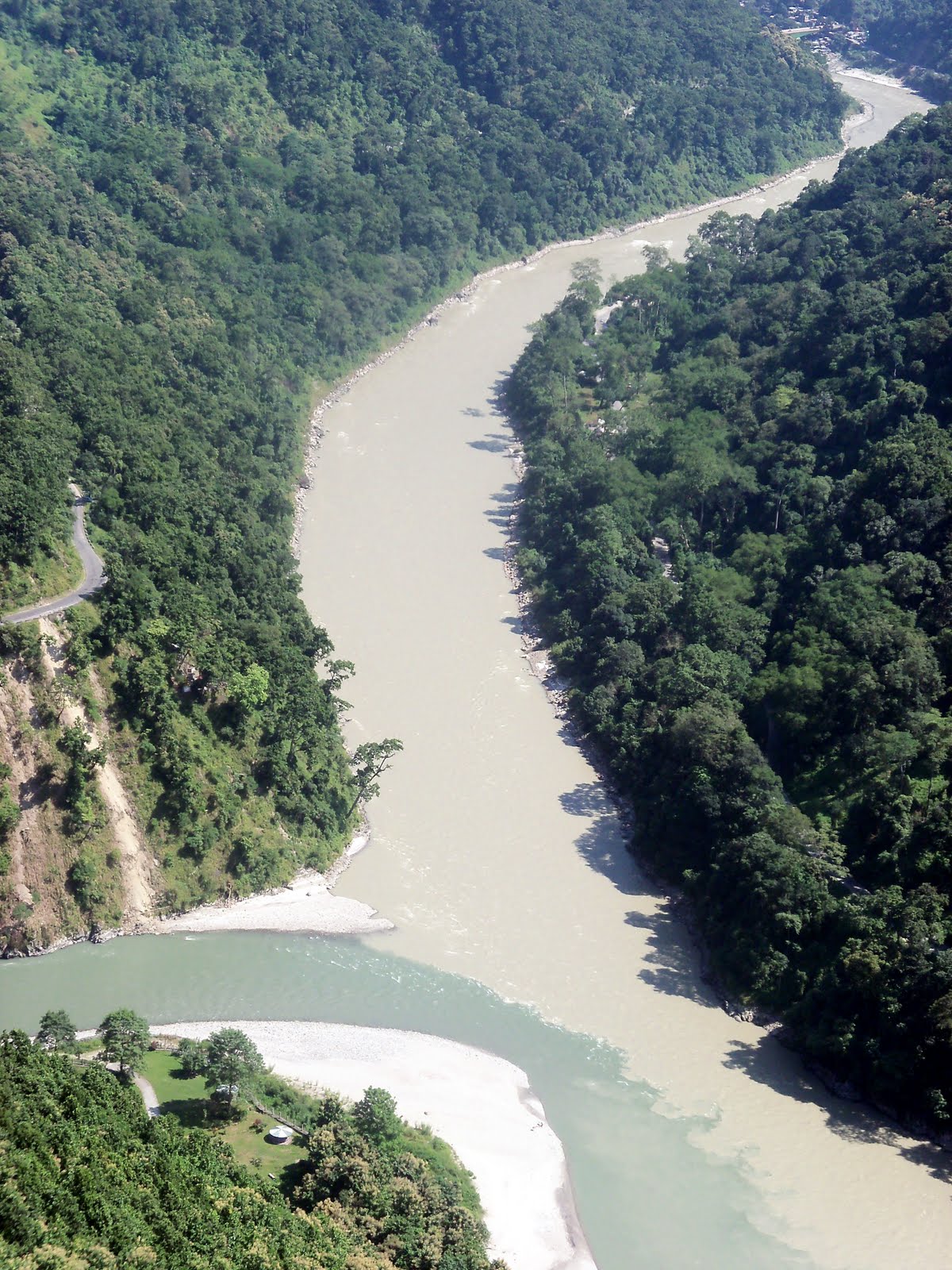
We crossed a bridge over Teesta and ascended to a high point where the road took a sharp turn. Gosh! There was a confluence of two mighty rivers, Teesta & Rangeet about 1000 meters below us. What is amazing is that the colours of the two are clearly separable: the light brown of former & the dark green of the latter flowing along awhile. A cup of tea, some Chana Chat and a friendly chat with roadside vendors & we were on our way again.
‘Tomorrow is Dussehra. It’s our main festival in the hills. We worship our parents and if they are no more, their photographs. They apply Tika of rice on our foreheads; give us new clothes & money. We eat meat, drink & gamble’. ‘Drink’, I frowned. ‘Yes. The eldest gets rum, the younger men, beer but the boys, only milk or lassi. These are shaguns.’ I reminded my colleague that I was the eldest in the group but never got more than a cup of coffee so far.
We checked into Swiss Hotel around noon & were out soon to look for animals in the zoo. A wild boar and crackling sounds of a few exotic birds greeted us at the entrance. Few that could be spotted in other enclosures looked fatigued and sleepy. We ventured into the museum of the Himalayan Mountaineering Institute looking at ice-axes & snow-boots. We raced to the Tenzing Rock where, it was claimed, the Sherpa who climbed Everest used to practise. We were sceptical but let the young boy, U., roap-climb to the modest top. A., his sister, did not buy my offer of money to give it a try. Leos know what they crave for! Gombu Rock, across the road, a tougher target, hardly had any takers.
We spotted a few bamboo kiosks selling Darjeeling tea & snacks. Through them, lay a kuccha path around a few tea plants. The real gardens lay beyond. We were spell-bound by the patterns they made over the mountain slopes. The evening was spent on the Mall picking up bric-a brac from Tibetans and walking right up to Chorasta across some top confectionary shops & bars. Being in the company of teetotallers, I resisted the temptation citing Lord’s Prayer silently.
We were racing to the Tiger Hill at 4 next morning to see the Sunrise. The kids, like the shopkeeper who sold curios on the Mall, complained that Sun rises everywhere but trudged along. We had to trek the last mile as countless cars had blocked the way. Diesel fumes polluted the hill air. We looked around at the railing. Not an inch of space. I stood on my toes to catch a glimpse. The mountain sky soon changed crimson and the Sun, more like an electric bulb, shot up to the excitement of the crowd. To the Left, the Kanchenjunga peak caught the first rays from the East & shone majestically. Meanwhile the Tibetan girls, with cans in front kept shouting ‘Coffee! Cigarettes’ to people lost in nature’s glory.
We stopped at Batasia Gurkha War Memorial, partly to pay homage to the sturdy martial race & also to taste some pakodas and garam chai. Born spoiler that I am, I couldn’t resist taking to task the man who was selling tickets. ‘Why don’t you guys put the tiles, which have broken off the memorial, back in place? He was surprised, apologetic and assured me that it was being done. We ordered another cup of tea in relief.
Mirik, situated at an altitude of 1780 m, was the next destination. Dipak Rai, the driver for the day, halted at Jorpokhri lake, which was full of noisy ducks giving themselves a good wash. For driving us on the festival day, he was getting another hundred rupees. We stopped en route & went across the road. One could see a tiny hamlet at a distance. ‘You are standing in Nepalese territory’, the lady vendor informed us. A cheerful young girl with pink cheeks kept screaming at the group of visitors. ‘Buy at least something worth five rupees’. Our mobile phones promptly displayed NCell signs & an SMS wished us a pleasant stay in Nepal.
Mirik has a small, placid lake with wind causing ripples on its cool surface. Boating was ‘closed’ and the kids, nauseous with fast driving on serpentine hilly roads, refused to go anywhere near the horses. When nothing else works, try Punjabi food! We located Jagjit restaurant & ordered aloo-paranthas with solid dahi. The old, burly Sardar soon had more customers than he could handle on Dusshera day & ordered the main door closed. On our way back, at the border, a disinterested Indian policeman jotted down my name in a register, added ‘+6’ against it & told us we were free to go as far as Kathmandu. That’s what you call a porous border!
We shelled out 200 rupees on the Nepali side for just a 1 km ride to the lack-lustre Pashupati market & back. Hardly any shoppers since post-liberalisation, most of the stuff on sale, can be seen in any Indian market. No wonder, the Custom check-post, where kids from my wife’s school had their electronic toys confiscated years ago, was now reduced to a site-sign. Our ‘pleasant stay in Nepal’ lasted only 30 minutes.
We drove through more tea-gardens on hills and plains, to reach Bagdogra airport at 7.30 a.m. on the final day. The lone sentry informed us that the Staff will report for duty only at 8 a.m. so we sat on our trolleys surrounded by dead insects, littered poly-packs & used pet bottles: the gateway to the exotic hills of West Bengal.